

Yes — medical tourism is safe when coordinated through a physician-led platform with JCI-accredited hospital partners. For families in Saudi Arabia and across the GCC, while local healthcare systems provide excellent routine care, complex cases often require the highly specialized expertise found in global medical hubs. This report evaluates the critical intersection of patient safety, international accreditation, and the specific cultural requirements of Saudi patients seeking treatment abroad.
When a family member faces a serious diagnosis, the pressure to find the “best” treatment can sometimes overshadow the necessity of the “safest” coordination. Healtra serves as a vital bridge in this process, ensuring that medical travel is not a gamble but a structured clinical pathway led by experienced physicians.
The following analysis details how JCI accredited hospitals abroad and rigorous patient safety standards in medical tourism create a secure environment for healing.
Healtra vs. Standard Facilitators
When it comes to your health, safety should always be the priority. This comparison highlights the differences in safety standards between Healtra, a specialized physician-led service, and standard medical tourism agencies. By choosing a company that meets these criteria, you can ensure your medical journey in Saudi Arabia is safe and stress-free.
| Safety Criteria | Healtra (Physician-Led) | Standard Agency | Why it Matters |
| JCI Accreditation | ✅ | ❓ (Variable) | Ensures the hospital meets internationally recognized standards for patient safety and quality. |
| Physician-Led Medical Review | ✅ | ❌ (Often Administrative) | A medical doctor reviews your case before you travel, not a sales agent, ensuring clinical suitability. |
| Arabic Language Support | ✅ | ❌ (Sometimes only English) | Eliminates miscommunication with medical staff, ensuring accurate diagnosis and informed consent. |
| Transparent Pricing | ✅ | ❓ (Often hidden fees) | A clear, detailed quote means you won’t face unexpected financial stress while abroad. |
| Integrated Post-Care Follow-up | ✅ | ❌ (Ends upon departure) | Coordinates the critical transition of your medical care with your local GP once you return home. |
The Evolution of Patient Safety in Global Healthcare
The modern landscape of medical travel for Saudis is no longer defined by adventurous “health holidays” but by highly regulated medical migration.
Safety is now a quantifiable metric, measured by adherence to the patient safety standards in medical tourism set by international bodies like the Joint Commission International.
For a Saudi family, the “Gold Seal” of JCI accreditation is the primary indicator that a hospital in Turkey or India operates at a Western standard of care.
Comparison of Care Standards: Accredited vs. Non-Accredited Facilities
| Safety Feature | JCI Accredited Hospital Abroad | Non-Accredited/Budget Clinic |
| Surgical Protocol | Mandatory site marking and double-verification. | Non-standardized, higher risk of site errors. |
| Infection Control | Rigorous clinical audits and sterilization monitoring. | Variable standards; higher hospital-acquired infection rates. |
| Staff Competency | Verified credentials and continuous medical education. | Unverified qualifications; potential for “trainee” surgeons. |
| Medication Safety | Barcode scanning and double-pharmacist checks. | Manual entry; higher risk of diagnostic/dosage errors. |
| Patient Rights | Legally protected informed consent and transparency. | Limited legal recourse; opaque pricing and risks. |
Identifying Medical Travel Risks and Complications
While the benefits of specialized care are vast, understanding medical travel risks and complications is the first step in mitigating them.
The most common clinical risks involve the physiological stress of travel combined with the recovery requirements of major surgery.
Patients often underestimate the risk of Deep Vein Thrombosis (DVT) during long-haul flights back to Riyadh or Jeddah after a procedure.
Primary Clinical Risks for GCC Medical Tourists
- Infection Control Gaps: Exposure to antibiotic-resistant bacteria not prevalent in the home country.
- Communication Barriers: Misunderstanding critical post-operative instructions due to language differences.
- Continuity of Care: The “gap” between the international surgeon and the local Saudi GP upon return.
- Thromboembolism: Increased risk of blood clots when flying too soon after orthopedic or cardiac surgery.
WhatsApp Advisor now to discuss your specific medical condition and how Healtra mitigates these travel-related risks.
Why Saudi Families Choose Healtra for Medical Travel Abroad
Trust and transparency are the most valued commodities for Saudi families making life-altering medical decisions.
Healtra is not a travel agency; it is a physician-led coordination platform founded by doctors with 25 years of GCC healthcare experience.
This medical background allows Healtra to review every case clinically, ensuring that recommendations are based on patient outcomes, not commission.
The 72-Hour Medical Planning Advantage
Anxiety is often a patient’s greatest burden, which is why Healtra guarantees a treatment plan within 72 hours.
Within this window, the medical team reviews reports, consults with global experts, and provides a transparent cost estimate.
This speed ensures that patients with deteriorating conditions, such as oncology or neurosurgery needs, do not face harmful delays.
| Milestone | 0 – 24 Hours | 24 – 48 Hours | 48 – 72 Hours |
| Process | Medical report intake and clinical summary. | Outreach to vetted JCI hospitals in network. | Final plan, cost estimate, and doctor intro. |
| Goal | Establish medical baseline. | Secure specialized opinions. | Empower family decision-making. |
Cultural Nuances: Protecting Saudi Values Abroad
For the Saudi patient, a hospital’s technical excellence must be matched by its cultural competence.
Safety includes the psychological well-being of the patient and the active involvement of the family decision-makers.
Healtra ensures that all partner hospitals provide gender-sensitive care, prayer spaces, and halal-certified meals.
The Role of the Family Spokesperson
In Arab culture, medical decisions are often a collective responsibility, with the eldest male frequently acting as the spokesperson.
A “safe” medical journey requires a coordination team that respects this hierarchy while ensuring the patient’s clinical rights are protected.
Healtra provides full Arabic language assistance to bridge the gap between Western medical protocols and Saudi family values.
Top Destinations: Where is Medical Tourism Safe for Saudis?
Selecting the right destination is a strategic choice that balances specialized expertise with logistical reliability.
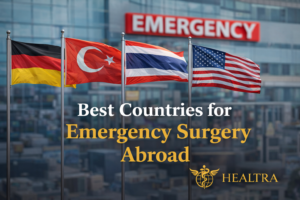
Healtra focuses on a vetted network of hospitals in Germany, Turkey, India, the USA, and the UAE.
Each of these hubs offers distinct safety advantages for various medical specialties sought by GCC patients.
Analysis of Global Medical Hubs for GCC Patients
| Destination | Primary Strength | Safety Accreditation | Cultural Proximity |
| Germany | Orthopedics & Complex Rehab | ISO 9001 / National | Moderate |
| Turkey | Cosmetic & Specialized Surgery | JCI Gold Seal | High |
| India | Cardiac & Oncology | JCI / NABH | Moderate |
| USA | Rare Disease & Cancer Research | JCI / CMS | Low |
| UAE | Elective & Multi-specialty | JCI Gold Seal | Very High |
Advanced Clinical Vetting: The Healtra Standard
Healtra’s vetting process goes beyond checking for a JCI logo; it involves a deep dive into surgeon expertise and hospital outcomes.
The “procedure volume effect” is a key safety indicator—teams that perform the same surgery thousands of times have lower complication rates.
Healtra’s doctors evaluate the specific physician who will perform the surgery, their training, and their success rates in similar cases.
Ensuring Transparency in Pricing
One of the greatest risks in medical tourism is “hidden costs” that cause financial stress during recovery.
Healtra provides itemized, transparent cost estimates that include the surgeon’s fees, hospital stay, and pre-op tests.
This transparency is a pillar of trust, allowing families to focus on healing rather than unexpected medical bills.
Submit Medical Reports now for a transparent, physician-verified cost estimate within 72 hours.
Post-Operative Safety: The Return to Saudi Arabia
The most critical phase of medical tourism abroad is the first 30 days following the patient’s return to the Kingdom.
A “genuine post-operative follow-up” must include scheduled remote consultations and medical coordination with local Saudi doctors.
Healtra facilitates the transfer of translated medical records to the patient’s home physician to ensure continuity of care.
The “Fit to Fly” Assessment
Before returning to Riyadh or Dammam, patients must undergo a clinical assessment to ensure they can safely tolerate cabin pressure.
Healtra coordinators manage these logistics, ensuring that patients do not fly prematurely and increase their risk of travel complications.
Many patients fear that if a procedure goes wrong abroad, they will have no legal standing or support.
Selecting a JCI-accredited hospital through a reputable platform like Healtra provides a layer of protection through established ombudsman programs.
Reputable providers are transparent about patient rights and the legal framework for medical malpractice in their destination country.
Conclusion: Empowering Your Medical Journey
So, is medical tourism safe? The answer is a resounding “yes,” provided it is managed with clinical expertise and cultural intelligence.
By prioritizing JCI accredited hospitals abroad and utilizing a doctor-led coordination service like Healtra, Saudi families can access the world’s best care without compromise.
Healtra.co remains committed to being the most trusted bridge for GCC patients, offering transparency, speed, and safety in every medical plan.
Don’t leave your family’s health to chance. Choose a pathway built on trust and 25 years of medical excellence.
Take the first step toward world-class treatment today:
Submit Medical Reports: Send your files via WhatsApp or our secure portal for a clinical review.
Your health deserves the best. We make it a reality..
The Deep Science of JCI Standards: Why It Matters for Your Family
To truly understand if medical tourism is safe, we must look at the specific mechanisms of clinical audits.
A JCI-accredited facility must adhere to the International Patient Safety Goals (IPSG), which are designed to eliminate the most common medical errors.
For a Saudi mother traveling for cardiac surgery, these goals translate to concrete safety measures in the operating room.
The Six International Patient Safety Goals (IPSG)
- Identify Patients Correctly: Using two identifiers (e.g., name and birth date) before any medication or procedure.
- Improve Effective Communication: Standardizing “read-back” protocols for verbal orders and critical test results.
- Improve the Safety of High-Alert Medications: Storing concentrated electrolytes and other dangerous drugs in locked, labeled areas.
- Ensure Safe Surgery: Implementing the “Universal Protocol” of site marking and a pre-surgical time-out.
- Reduce the Risk of Health Care-Associated Infections: Implementing strict hand hygiene and sterilization audits.
- Reduce the Risk of Patient Harm Resulting from Falls: Assessing every patient for fall risk and implementing preventive measures.
When Healtra selects a hospital for your medical travel abroad, we ensure these IPSG protocols are the bedrock of their clinical practice.
Analyzing the 72-Hour Response Time: Efficiency vs. Safety
Many patients ask: “How can a medical plan be safe if it is generated in only 72 hours?”.
The answer lies in Healtra’s pre-vetted infrastructure. Our physicians have already audited the clinical outcomes of our partner hospitals.
When your medical report arrives, our team isn’t starting from scratch; they are matching your specific diagnosis to a known “Center of Excellence”.
The Clinical Logic of Rapid Coordination
- Hour 1-12: Initial clinical triage. Our doctors review your MRI, pathology reports, and history.
- Hour 12-36: Concurrent outreach to the International Patient Departments (IPD) of JCI-accredited hubs.
- Hour 36-60: Comparison of treatment modalities. Does the surgeon in Turkey suggest a more minimally invasive approach than the one in India?.
- Hour 60-72: Consolidation of the plan. Translation into Arabic and final verification by our CEO, Dr. Mohammad Aldaly.
This rapid response prevents “medical window” loss—the critical period where a condition is most treatable before it progresses.
The Economic Reality: Cost Savings vs. Clinical Quality
Is medical tourism safe when it costs 70% less than local private care?.
The cost advantage in countries like India or Turkey is not driven by lower safety standards, but by lower labor costs and favorable exchange rates.
In fact, the hospitals Healtra partners with often use more advanced technology (such as the Da Vinci robotic system) than local GCC clinics.
Cost-Efficiency Table: Procedures for Saudis Abroad
| Procedure Type | Estimated Cost (USA/Europe) | Estimated Cost (Turkey/India) | Healtra Safety Oversight |
| Cardiac Bypass | $150,000 | $10,000 – $15,000 | JCI Cardiac Hub Vetting |
| Knee Replacement | $40,000 | $6,000 – $8,000 | Orthopedic Post-Op Protocol |
| IVF Treatment | $20,000 | $4,000 – $6,000 | Ethical & Cultural Review |
| Oncology Care | Variable (High) | 40-60% Savings | Multidisciplinary Team Review |
Book Medical Consultation to receive a personalized, safe, and cost-effective treatment quote.
The “Patient-Centered” Environment: A Cultural Necessity
For families in Saudi Arabia, safety and comfort are inseparable. A patient who feels culturally alienated is more likely to experience stress-related complications.
Healtra emphasizes the “human expertise” pillar of safety. This includes doctors who not only speak your language but understand the role of faith and family in the healing process.
Religious and Traditional Considerations
- Prayer Times: Ensuring medical checks do not unnecessarily disrupt the patient’s religious duties.
- Dietary Needs: Halal-certified nutrition is essential for post-operative recovery and metabolic health.
- Modesty and Gender: Arranging for female staff or chaperons to ensure the comfort of female patients during examinations.
By addressing these “soft” safety factors, Healtra builds the trust necessary for a successful medical outcome.
Risks of “Self-Arranged” Medical Travel
The internet is filled with “medical tourism scams” and unverified clinics that prioritize marketing over medicine.
Patients who book directly with clinics often lack an independent advocate if complications arise.
Healtra acts as your advocate, providing a layer of “clinical governance” that protects you from non-accredited facilities.
The Healtra Advocacy Model
- Independent Review: We have no commercial bias toward any single hospital; we recommend what is medically best.
- Clinical Escort: For complex cases, we can arrange for medical personnel to accompany the patient during travel.
- Logistical Support: While we focus on medicine, we ensure your visa and accommodation are coordinated for maximum safety.
WhatsApp Advisor to avoid the risks of unverified medical travel and ensure a doctor-led journey.
Future Outlook: Saudi Vision 2030 and Global Integration
As Saudi Arabia continues its “income revolution” through healthcare transformation, medical tourism becomes a tool for knowledge exchange.
Patients traveling abroad often bring back insights that help improve local clinical practices, creating a global network of excellence.
Healtra supports this vision by building long-term medical referral channels between GCC physicians and global centers of excellence.
Final Checklist: Is Your Chosen Hospital Safe?
Before you travel, use this Healtra-approved checklist to verify your safety:
- [ ] Is the facility JCI or NABH accredited?
- [ ] Has a GCC-experienced doctor reviewed your treatment plan?
- [ ] Is there 24/7 Arabic support available at the destination?
- [ ] Do you have a written, itemized cost estimate with no hidden fees?
- [ ] Is there a defined post-operative follow-up plan for when you return to Saudi Arabia?
If you cannot check all these boxes, Submit Medical Reports to Healtra today, and let us secure your medical future.
Healtra.co: Your Health, Our Expertise, Your Peace of Mind.
Ask a Doctor: Addressing Your Safety Concerns with most FAQs
Navigating medical travel involves more than just logistics—it requires clinical confidence. Our medical team addresses the five most common safety concerns for Saudi patients traveling abroad.
| Patient Concern | The Physician’s Perspective |
| How do we manage infection risks abroad? | We exclusively partner with hospitals maintaining JCI-accredited infection control protocols. These facilities undergo rigorous audits for sterilization and air filtration (HEPA) that often exceed baseline international standards, significantly minimizing post-operative risks. |
| What happens if there is a complication during surgery? | Safety is built into the selection process. We only facilitate surgery in Tier-1 multispecialty hospitals that possess 24/7 ICU capabilities and on-site rapid response teams. Unlike boutique clinics, these institutions are equipped to handle any surgical emergency immediately. |
| How is my follow-up care managed back in Saudi Arabia? | Your recovery doesn’t end at the airport. Healtra Medical Team provides a clinical handover report for your local physician and schedule mandatory virtual follow-ups with your operating surgeon. This ensures a “continuum of care” that bridges the gap between the international hospital and your home. |
| Will language barriers affect my medical safety? | Miscommunication is a clinical risk. We provide Arabic-speaking medical coordinators who attend consultations to ensure that symptoms, history, and “informed consent” are perfectly understood by both the patient and the surgical team. |
| How do I know the surgeon is actually qualified? | Beyond basic licensing, our medical board performs a Physician Credentialing Review. We verify specific case volumes, success rates for your particular procedure, and international fellowships to ensure you are in the hands of a true specialist, not a generalist. |